Welcome to Éire Literature! I’m using this page to share my personal works while I’m in college and have the time to write freely. Hope you enjoy!

Tag: fiction

  • Even Statues of Women Aren’t Safe

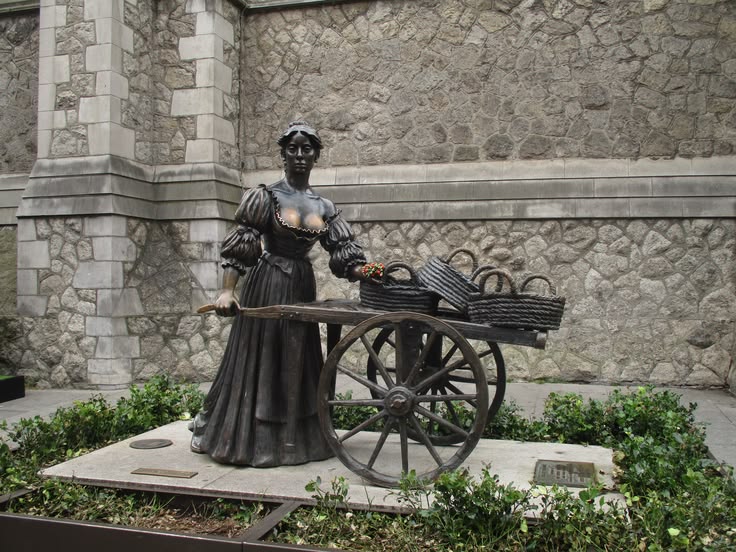
    The famous statue of Molly Malone resembles a woman in a long dress pushing a cart in central Dublin. It was unveiled in 1988 to celebrate the city’s millennium on Grafton Street before being moved to Suffolk Street around 2014. The figure is supposed to portray the woman in the city’s unofficial anthem of “Cockles and Muscles.” The simple folk song is about Molly Malone, a fish merchant like the rest of her family, but she dies young from fever. She’s been a symbol of Irish pride and a reminder of the hardships the country has overcome. This attention led her to become a popular tourist attraction for visitors, both Irish and foreigners. 

    Once images and videos of this statue started to appear online in 2022, it became a media sensation, but not for a good reason. Other tourist attractions, like the Blarney Stone, are meant to be touched for good luck, but Molly’s statue was rusted everywhere except for her breasts. People all across the globe started to vocalize how degrading and disgusting the normalized custom was. Instead of taking a photo with her, tourists were rubbing the statue of a young woman’s breasts for good luck. This sensation began to reach media outlets in Ireland as well as overseas. Thousands were outraged and began to stop people in public from participating in the long-running tradition. 

    Numerous women were instead posting videos on different online platforms holding Molly Malone’s hand instead of her breasts out of respect and protection for her. Blatantly demonstrating how even a statue of a woman isn’t able to get respect. Tourists and influencers tried to guide things in a positive direction, encouraging future tourists visiting Dublin to hold her hand instead. Women during the annual St. Patrick’s Day parade held Molly Malone’s hand and covered her bust with flowers or necklaces. The city had Gardaí (Police Force) on each side of the statue during the month of May 2025 to halt citizens from violating the statue in an attempt to educate visitors. Even a young woman at Trinity College Dublin, who often busks on Suffolk Street, started a campaign titled “Leave Molly mAlone.”

    After continuous attention, Dublin City Council decided to refurbish the statue in early October 2025. It was cleaned, and the bronze was restored to her chest, then unveiled on October 10-11 of 2025. The once humiliating and derogatory tradition was starting to be put to rest. Media outlets and Irish citizens were satisfied with the refurbishment as well as the acknowledgement from the city, and started to move on. The media posts have since ground to a halt, and news stations have stopped reporting it. 

    The one thing I’ve yet to see covered is the statue now, after the restoration. The media is often fast-moving, and viral pieces or stories start to be forgotten, but Molly Malone shouldn’t be. As of late 2026, the statue is already starting to fade on her breasts once again. As much as the online feminist movement tried to change the tradition to holding her hand, it hasn’t worked, and the practice is still occurring. We are in a so-called “time of equality and progression,” but these repeated small acts show how far we still need to come. The tradition of Molly Malone is just one example of misogyny embedded in our history and society. Attention needs to remain on stories like this so people are held accountable and continue to shed light on normalized sexism. 


    Her Campus – Chapman University

    Erin Sweeney – Staff Writer

    @hercampuschapman

    https://www.hercampus.com/school/chapman/even-statues-of-women-arent-safe/

  • Chewing Gum

    He lifted his tall frame onto his feet with his hands clutching his pant leg, as my aunt silently ushered him out of the pew. I sat with my legs dangling off the smooth wooden bench and my black dress over my knees. As he moved towards the altar, I glanced back at the giant frames of faded stained glass that covered the small church. The weather was sad and gloomy, making it hard to see with no sunshine coming through. I turned my attention back to the front of the room, where Gary had finally reached the microphone. It was so silent I could hear my heartbeat in my ears along with every breath through my nose. 

    The pews were lined with older adults, all dressed in black, now looking at Gary. I only saw a few slightly familiar faces in the front rows, holding back tears, but before I could figure out who they were, the microphone static started. 

    “Um…Thanks all ye for coming. It really means a lot to me and my family.” Gary mumbled into the mic; I could still hear the nasal sound in his voice from crying. 

    My aunt clutched my hand tightly as she closed her eyes and sucked in a painful breath. My mother glanced back at my sister and me from the front pew as she sat next to my father, who couldn’t muster any words or reassuring looks. His glasses were fogged with tears, and his eyes pink. Every few minutes, he would take his glasses off to wipe them on his suit, before placing his thumb and his pointer finger on the bridge of his nose, as if he almost believed it would stop the crying or the pain. He repeatedly sucked in a few short breaths, trying to stay silent. I felt like I was the only one who noticed. My father never cried; this might have been the first time I ever saw him, at least that I can remember. 

    “It’s okay, it’s okay.” He whispered with a forced, tiny smile on his face as my mother placed her hand over his. 

    We turned our attention to the casket covered in flowers and photographs in front of us. My grandad’s portrait was lovely. He smiled very brightly, and the green landscaping of rural Ireland in the background made it look almost heavenly. He wore very similar glasses to the ones my dad does now, thick black frames with clear lenses. His wispy white hair combed on either side of his head. Irish funerals were always unique compared to our American traditions. His casket stayed in the house with us for the past few days, making it much harder to say goodbye. Photos of my nana alongside him were everywhere with endless bouquets of flowers, but I couldn’t spot her in the crowd of tears. 

    Gary glanced down at his hands nervously, not being able to keep still. He wiped his face quickly with one knuckle before taking a deep breath and starting his speech.

    “Tony was a brilliant man…*click* He never had a bad thing to say about anyone…*click*”

    I cocked my head, confused and trying to listen closer. He talked of how extraordinarily kind our grandfather was, how he was never angry and never raised his voice. Between every few words, there was a click that distracted me from his sentiments. I glanced around me to see if I was the only one hearing this obvious disruption. The next time it happened, I caught my aunt’s eye. All she did was close her eyes with a smile, almost like she was holding back laughter. The first time I had seen her smile that day, which made me hold back a smile too. 

    “Colm, He forgot to take the gum out of his mouth.” She whispered with a giggle to my uncle on the other side of her. 

    “What?” He questioned with a thick Irish accent, thinking he had probably misheard her. 

    “He didn’t take the gum out of his mouth,” she repeated before sharing a slight smirk with my father in front of her. 

    “Oh Jesus Christ,” he muttered before slumping down in his seat to hear his son’s continuous chewing. 

    As much as it bothered them, it was like a sliver of hope for me. It was the first real conversation in far too long. Almost reassuring me that we would be okay and things could go back to normal. Gary finished speaking and jogged down the carpeted stairs back into his seat. The speakers started to play “In the Arms of the Angels” by Sarah McLachlan, and the rows behind me began crying. Though I was too focused on my aunt telling her son to take the chewing gum out of his mouth. For the first time that day, we were the only ones not crying.