Welcome to my page! I’m using this blog to share my personal works while I’m in college and have the time to write freely. Hope you enjoy!

Tag: philosophy

  • Is Love an Option?

    I was recently asked the question “Is Love an Option” by one of my close friends. Although I wouldn’t say I’ve experienced the cliche version of love that we all know it to be. I’ve experienced many different types of love: familial, platonic, and a type of romantic affection. Love comes in all shapes and sizes, but do we really know how it starts? Having a crush or being attracted to a person can come naturally or be all consuming, but love doesn’t follow that same criteria. Love is slow and almost goes unnoticed until you find that it’s already there. I’ve watched everyone around me fall in and out of love over the years, and it honestly never looks appealing. I’ve watched my friends fight over trivial things with their boyfriends but refuse to see their flaws at the same time. Once I decide to question them, I always get the same line: “You’ll understand when you’re in love.” 

    This remark used to irritate me; I felt like a child being scolded by an adult for something I couldn’t comprehend. Since I was young, I’ve loved the idea of romance, whether it be in books or films, I couldn’t get enough of it, but the way love is interpreted in these forms is very different to the real world. Love is scary and unsettling; you never really know the outcome. Yet we still continue to love as much as we can, over and over again. Maybe it’s humans that have this affliction; we are made to naturally crave love. Some have a worse affliction than others and take whatever they are given. Even the phrase “I love you” is confusing. It’s commonly said between friends and family, but when it comes to romantic relationships, no one has the answers. Everyone I know has said the phrase at different points in their relationships, and every single one of them still doesn’t think they got it right. Too early or too late, or the wrong timing altogether. Why is it that these types of relationships are so hard to navigate? Even the sayings regarding love make it sound unnerving: “Love makes you crazy” or “Love conquers all.” 

    For those like me, who haven’t experienced this form of love, it sounds frightening and controlling. Romantic love from an onlooker’s perspective doesn’t look pretty or desireable; it seems like something no human on earth has fully figured out. Every piece of literature I’ve read has been influenced by some sort of love, and it always ends with tragedy or change. All of these factors seem to indicate that love is necessary to human life and progression; everything we do involves love. Whether it be protecting our families, hugging our friends, or being with the ones we love. Even if I decided that love was an option, it seems as though humans can’t help but pick love again and again.  

  • Caught in the Web

    The metaphorical meaning behind spiderwebs has been explored in literature for thousands of years, dating back to the 6th century BCE, when it was often used in Greek philosophy to convey fragility and political discourse. Spiderwebs or cobwebs can be seen as intricate, fragile, yet dangerous and trapping at the same time. Spiders place bait to catch their prey, leading them to their demise. They are also similar to snowflakes; the designs have radical symmetry and no two webs are the same. They are beautiful yet eerie in their purpose. We don’t often see hunting as something that is breathtaking. We wince every time we see gazelles being torn apart by lions on nature channels. Why is it that spiders get away from this conception? 

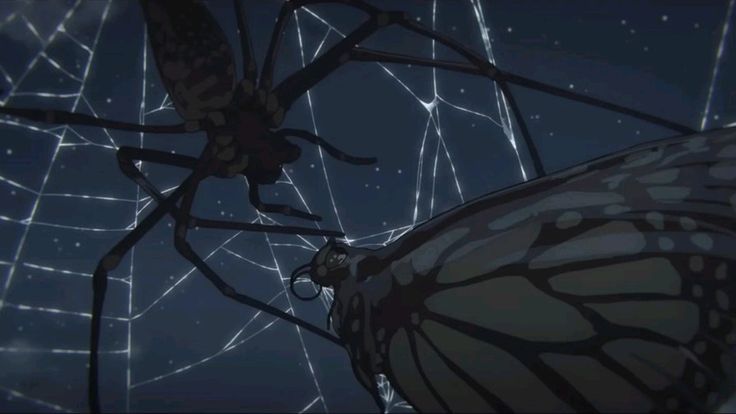
    The new ‘Chainsaw Man’ movie that recently aired this month briefly touches on this concept. The film is supposed to mess with our preconceived notions of fear and beauty. One of the most influential moments of the film is when the two main characters are teaching each other how to swim. While we watch this seemingly sweet and innocent action, we are clearly able to see the progression of a spider spinning its web. As the moment becomes more sinister and we feel a sense of dread as onlookers, we see a moth caught in the web, covered in drops of water above the pool. Once the scene ends, the spider is seen devouring the moth tangled in the web. This represents the ending of their childhood or innocence. They are both swimming without clothes on, but the scene is depicted in such a light and hopeful manner that it seems completely natural and childlike. The story depicts exactly this progression. 

    The story deeply explores the loss of innocence and how the characters seem much older than they are. We never realize this fact as watchers until they return to a school-like setting, and we realize that normal kids their age should be in classrooms. While the film explores innocence, it also carefully suggests that this is the product of raising children as weapons and state-directed violence. Although watchers are heavily targeted towards the main character, by the end of the film, we can see the battle between good and evil and the manipulation of both young characters. They were both used as assets by two different sides and never got to experience a real childhood. They never had a chance at real life. The spiderweb is the perfect analogy for what both characters experience. The web is the system that controls them, and the spider is the character who consumes the other, leaving them both with nothing.